Cartridge dust collectors
A cartridge collector packs pleated media into a fraction of the space a bag unit needs, which is why it is the default answer for most fine, dry industrial dust. Sized correctly it runs for years on the same cartridges. Sized badly it blinds off in months.
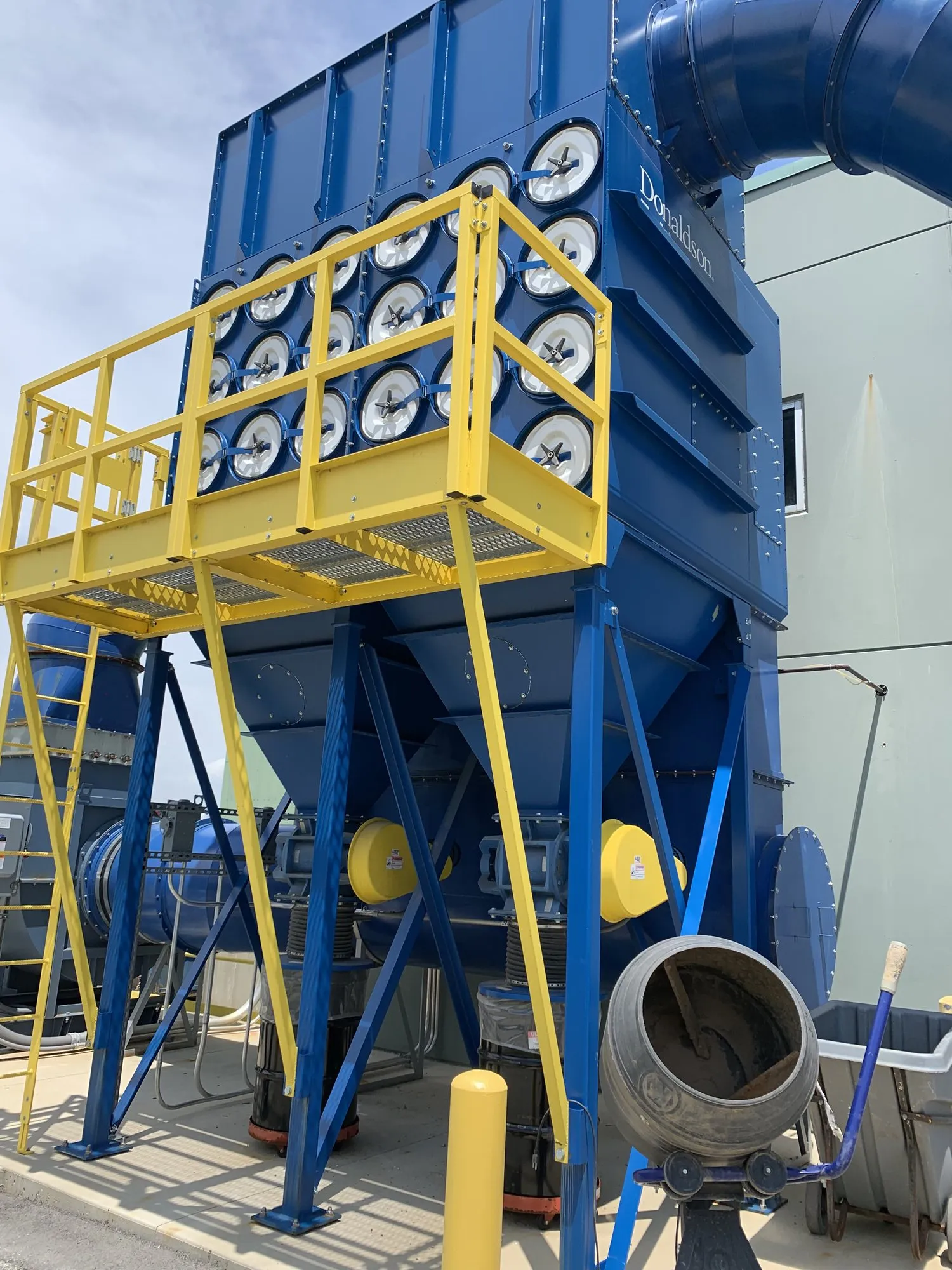
Where a cartridge collector is the right call
Fine, dry, free-flowing dust at moderate temperature — grinding and finishing dust, laser and plasma fume, powder handling, dry buffing. The pleated media gives you several times the filtration area of a bag of the same physical size, so the unit fits in a plant where a baghouse would not.
It is the wrong call for sticky, hygroscopic or very heavily loaded dust, and for high-temperature streams. Pleats that pack with a material that will not release are worse than no collector at all. When your dust points that way we will tell you and quote a baghouse instead.
Sizing is the whole job
Air-to-cloth ratio is where cartridge collectors are most often got wrong. Push too much air through too little media and you drive dust into the pleats, differential pressure climbs, and the cartridges are finished long before they should be. We size against your actual dust loading and particle characteristics, not against a catalog page.
Can velocity matters just as much and gets ignored more often. If upward air velocity between the cartridges is too high, dust knocked off during a pulse never reaches the hopper — it re-entrains onto the cartridge above it, and the unit never really cleans.
What we supply and install
We specify and supply the collector, then fabricate the hoods and ductwork and handle the mechanical install in-house — rigging and setting the unit, hanging duct, building the support steel, and tying it into your building. Start-up, airflow readings at every pickup point, and balancing are part of the job, not a change order.
Where the dust is combustible, explosion protection is designed in from the first sketch rather than added after an inspection.